

The 1970s took the huge outdoor music festival to another level. Hundreds of thousands of people packed racetracks, fields and fairgrounds to see some of the biggest names in rock, soul and popular music — often over several days.
Some of these gatherings rivalled or even surpassed Woodstock in sheer crowd size. From more than 600,000 people at the Isle of Wight to the extraordinary turnout at Watkins Glen, these were some of the biggest music festivals of the 1970s.
What Were the Biggest Music Festivals of the 1970s?
The biggest 1970s music festivals included the Isle of Wight Festival in 1970, Summer Jam at Watkins Glen in 1973 and California Jam in 1974. Each drew crowds numbering in the hundreds of thousands. Other enormous gatherings included the Atlanta International Pop Festival, Goose Lake, the Ozark Music Festival and Led Zeppelin’s 1979 appearances at Knebworth.
One famous festival is missing from this list for a simple reason: Woodstock took place in August 1969. Its influence hung over the following decade, but the original Woodstock was not a 1970s festival.
| Festival | Year | Location | Estimated attendance |
|---|---|---|---|
| Isle of Wight Festival | 1970 | Isle of Wight, UK | 600,000+ |
| Atlanta International Pop Festival | 1970 | Byron, Georgia | 200,000–300,000 |
| Goose Lake International Music Festival | 1970 | Michigan | About 200,000 |
| Summer Jam at Watkins Glen | 1973 | New York | About 600,000 |
| Ozark Music Festival | 1974 | Sedalia, Missouri | 100,000+, possibly around 250,000 |
| California Jam | 1974 | Ontario, California | About 300,000–400,000 |
| Knebworth Festival | 1979 | Hertfordshire, UK | Huge crowds; exact figures disputed |
Historic festival attendance figures are rarely exact. Gates were sometimes overwhelmed or opened entirely, and promoters, police and journalists often reported different totals. The figures below use conservative estimates from official histories and established archives where possible.
Isle of Wight Festival (1970): More Than 600,000 People
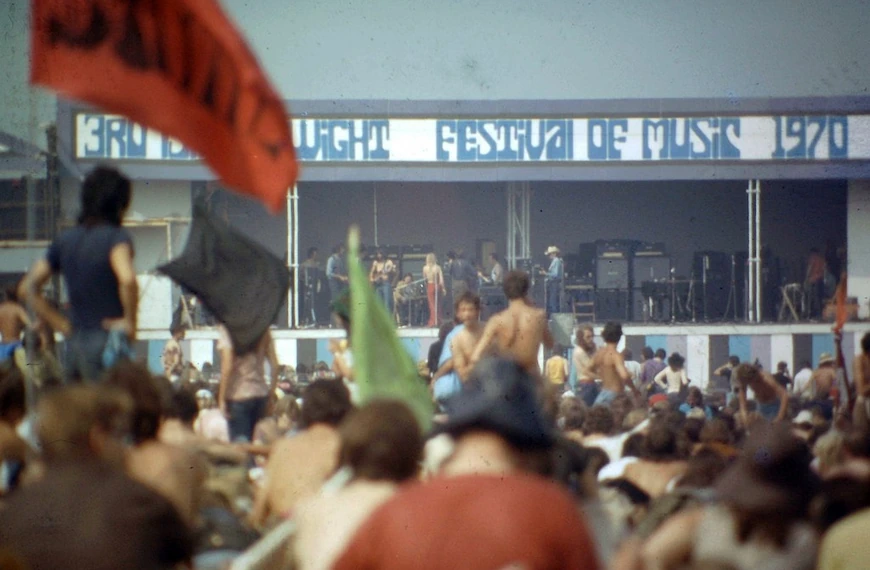
The Isle of Wight Festival was already established by 1970, but its third edition became something altogether different. The official festival history says more than 600,000 people attended the five-day event.
Notable performers: Jimi Hendrix, The Who, The Doors, Joni Mitchell, Leonard Cohen, Joan Baez, Chicago and Procol Harum.
The lineup reads like a cross-section of popular music at the start of the decade. It also became historically significant for Jimi Hendrix, who gave one of his final major performances before his death in September 1970.
The event proved difficult to control at that scale, and there would be no Isle of Wight Festival again until its revival in 2002.
Atlanta International Pop Festival (1970): 200,000 to 300,000 in Georgia
From July 3 to 5, 1970, an enormous crowd descended on the Middle Georgia Raceway near Byron, Georgia, for the second Atlanta International Pop Festival.
Organizers had prepared for roughly 100,000 to 150,000 people. Instead, the New Georgia Encyclopedia estimates that between 200,000 and 300,000 attended. When thousands of people without tickets pushed for entry, organizers eventually opened the gates and effectively turned it into a free festival.
Notable performers: Jimi Hendrix, The Allman Brothers Band, B.B. King, Johnny Winter and Procol Harum.
Hendrix played in the early hours of July 5 while fireworks lit the sky during his performance of “The Star-Spangled Banner.” The gathering remains one of the largest public events in Georgia history.
Goose Lake International Music Festival (1970): Michigan’s Forgotten Giant
Goose Lake is far less famous today than Woodstock or the Isle of Wight, yet its size puts it firmly among the biggest festivals of the era.
Held from August 7 to 9, 1970, in Jackson County, Michigan, the festival attracted approximately 200,000 people, according to the Rock & Roll Hall of Fame’s Library and Archives.
Notable performers: Rod Stewart and the Faces, Jethro Tull, Chicago, Ten Years After, Mountain, The James Gang, Bob Seger, MC5 and The Stooges.
The promoters had deliberately tried to solve some of the problems associated with earlier mega-festivals. Goose Lake featured extensive fencing, medical tents, improved restroom facilities and even coloured admission tokens instead of ordinary paper tickets.
Despite its enormous attendance and impressive lineup, Goose Lake never became an annual event.
Summer Jam at Watkins Glen (1973): Around 600,000 Fans
If you’re looking for the strongest answer to “What was the biggest music festival in the 70s?”, Summer Jam at Watkins Glen belongs near the top.
The one-day festival took place at Watkins Glen Grand Prix Raceway in New York on July 28, 1973. According to the New York State Police, an estimated 600,000 people attended — four times the 150,000 that promoters had expected.
Who played? The Grateful Dead, The Allman Brothers Band and The Band.
Just three groups were enough to bring traffic to a standstill. Vehicles clogged roads miles away before the music even started, yet police later described the event itself as generally peaceful.
Watkins Glen became famous not for elaborate staging or dozens of performers, but for the almost unbelievable scale of the crowd gathered for one very long day of American rock.
Ozark Music Festival (1974): Missouri’s Own Woodstock
On July 19–21, 1974, the Missouri State Fairgrounds in Sedalia were overwhelmed by a crowd far larger than organizers had expected.
The exact attendance at the Ozark Music Festival remains impossible to establish. Recent historical reporting puts it at at least 100,000 people, while people who have researched the event estimate that around 250,000 may have attended. Once the fences were breached and organizers stopped collecting tickets, accurate counting became impossible.
Notable performers: Eagles, Lynyrd Skynyrd, Aerosmith, REO Speedwagon, Bob Seger, Joe Walsh, America and Ted Nugent & The Amboy Dukes.
The massive turnout pushed the fairgrounds and the surrounding town to their limits. Food disappeared from local stores, traffic backed up and the festival effectively became a free-for-all. Today, Ozark remains one of the more overlooked giant festivals of the 1970s.
California Jam (1974): Up to 400,000 at a Motor Speedway

California Jam brought the mega-festival formula to Ontario Motor Speedway on April 6, 1974. The National Hot Rod Association’s history of the venue puts the crowd at roughly 300,000 to 400,000 people, making it one of the largest paid rock audiences of its time.
Who played? Eagles, Deep Purple, Emerson, Lake & Palmer, Black Sabbath, Earth, Wind & Fire, Rare Earth, Seals & Crofts and Black Oak Arkansas.
The event also showed how music festivals were changing. California Jam was a huge commercial production and parts of the concert were broadcast on ABC television.
Deep Purple supplied its most notorious moment when guitarist Ritchie Blackmore smashed a television camera and pyrotechnics around his amplifier produced a spectacular explosion.
A second California Jam followed in 1978, with acts including Aerosmith, Santana, Heart, Foreigner and Ted Nugent.
Knebworth Festival (1979): Led Zeppelin Closes the Decade
Led Zeppelin’s two shows at Knebworth Park on August 4 and 11, 1979 became some of the defining British rock events at the end of the decade.
Attendance is particularly difficult to pin down. Contemporary licensing allowed for around 120,000 ticket holders, while much larger estimates circulated after people reportedly entered through gaps in the perimeter. Rather than pretending there is one reliable figure, it is safest to say that each Knebworth show drew an enormous six-figure crowd.
Other performers included: Todd Rundgren’s Utopia, Southside Johnny & The Asbury Jukes, Fairport Convention, Chas & Dave and The New Barbarians.
The shows were Led Zeppelin’s first British concerts in four years and ultimately became the original quartet’s final UK appearances. Drummer John Bonham died the following year, after which the band disbanded.
Which 70s Music Festival Was the Biggest?
There is no perfectly reliable ranking because crowd estimates from 1970s festivals often vary enormously. However, the Isle of Wight Festival in 1970 and Summer Jam at Watkins Glen in 1973 both drew around 600,000 people or more according to strong historical sources.
That puts them well ahead of most other major gatherings of the decade. California Jam, Atlanta, Goose Lake and Ozark also attracted crowds that would still be extraordinary for almost any music event today.
How the 1970s Changed Festival Culture
The festivals of the 1970s showed that a concert could become much more than a few hours of music. Fans travelled across states and countries, camped for days and temporarily turned fields, racetracks and fairgrounds into cities of their own.
The decade also exposed the problems that came with that scale. Traffic, security, food, water, sanitation and crowd control became major challenges. Later festivals would professionalize many of those systems, but the basic idea — a destination built around several days of live music — was already firmly established.
Some of these giant 70s festivals disappeared almost immediately. Others became part of music folklore. Either way, their enormous crowds show just how central live music had become to the culture of the decade.
Explore More 70s Music
Want to keep going? Explore more stories in our 70s Music archive or test how much you remember with our 70s Music Quiz.
