
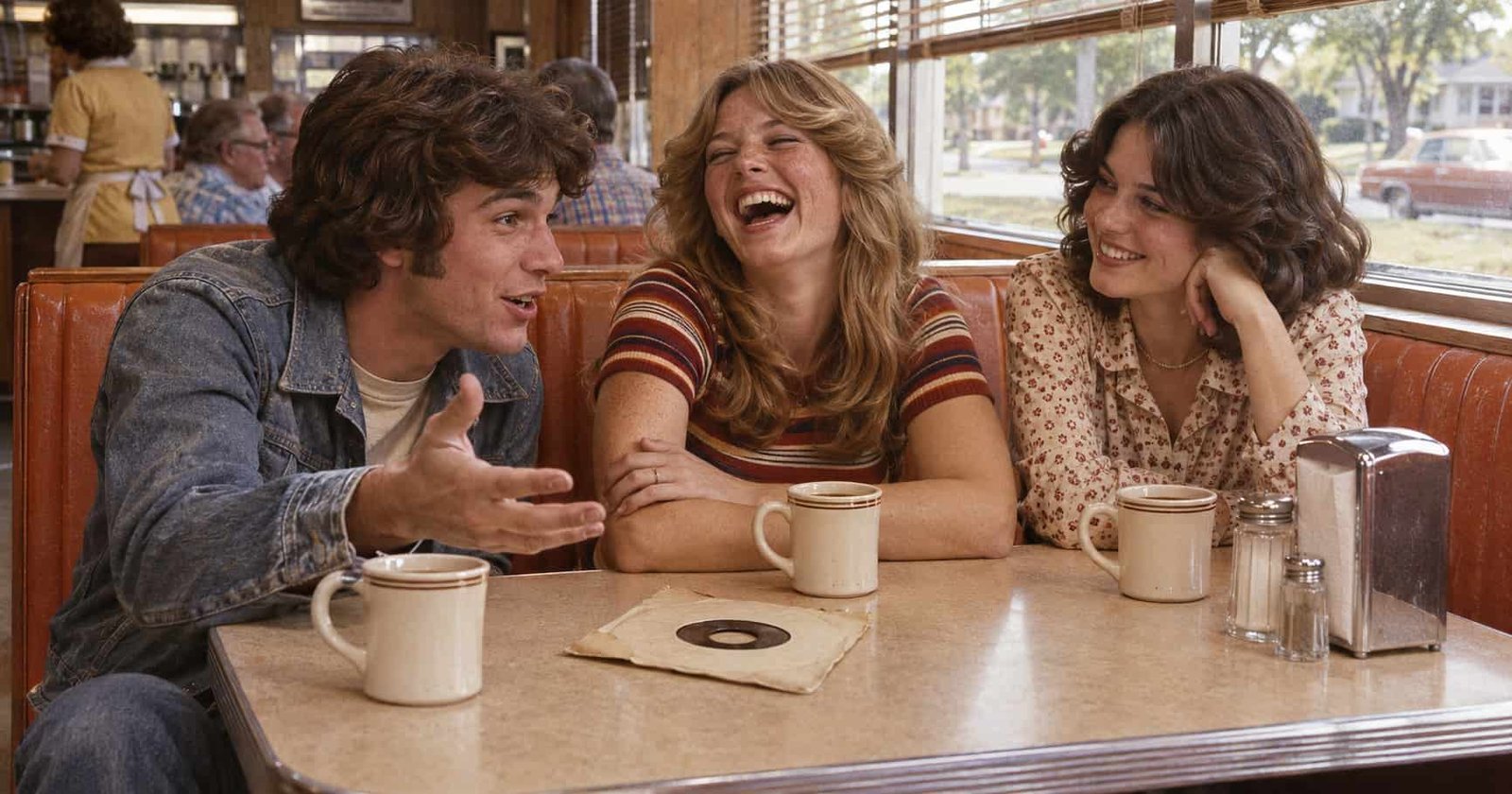
In the 1970s, an impressive record could be outta sight, a canceled concert was a bummer and a driver on the CB radio might answer 10-4. A teenager talking about music, a trucker calling another driver and a sitcom character answering back each had their own way of getting the point across.
These 35 examples of American 70s slang include everyday words, radio calls and TV catchphrases. Each entry gives the meaning, a short original example sentence and a place where the expression turned up from 1970 through 1979. Some of these 1970s sayings were already familiar when the decade began.
Jump to Everyday reactions · Around school and town · On records and the dance floor · On the CB radio · TV and movie catchphrases
Everyday reactions
A single word could take the place of a whole review. Groovy was a warm sign of approval, while heavy could tell a friend that a record or a conversation had left you thinking. Tone mattered, especially when bad was high praise.
1. Groovy
Meaning Great, appealing or just the way you like it. The word could describe a record, a jacket or a plan for Friday night.
Example “That’s a groovy poster for the school dance.”
1970s sighting Eugene E. Landy recorded the approving sense on page 93 of The Underground Dictionary (1971). By 1979, The Washington Post was already treating it as an expression that had fallen out of fashion. [1, 2]
2. Far out
Meaning An exclamation of surprise or admiration. You could use it to react to something exciting, remarkable or unexpected.
Example “Far out, you got front-row seats!”
1970s sighting In Saturday Night Fever (1977), Tony says it when Stephanie tells him about having business lunches with Eric Clapton and Cat Stevens. [3]
3. Right on
Meaning An enthusiastic way to agree, show support or tell someone they got it right.
Example “Right on, let’s give the drummer a solo.”
1970s sighting Marvin Gaye used the expression for a track title on What’s Going On (1971). The Library of Congress essay on the album describes it as a Black American expression of affirmation. [4]
4. Outta sight
Meaning Excellent or impressive enough to get an emphatic reaction. Out of sight is the full spelling of the same expression.
Example “That guitar solo was outta sight.”
1970s sighting In Bobby Seale’s memoir A Lonely Rage (1978), Jerry Rubin uses the full form in a scene with the other defendants. The citation appears on page 237 of the memoir. [5]
5. Bad
Meaning Strikingly good, impressive or skillful when said with admiration. Listen to the tone of voice to tell which sense is intended.
Example “Man, that’s a bad jacket you’ve got on!”
1970s sighting In his May 29, 1974 newspaper column on youth slang, Cleveland reporter Peter Almond recorded bad as a term of approval. His memoir preserves part of the column. [6]
6. Bummer
Meaning A letdown or an unpleasant turn of events. It also worked on its own as a brief response to disappointing news.
Example “Missing the last bus was a bummer.”
1970s sighting Bethany K. Dumas and Jonathan Lighter use the word in a sentence about a rough day in their spring 1978 article on slang in American Speech. [7]
7. Heavy
Meaning Serious, emotionally intense or powerful. In a conversation about music, it could describe something that made a strong impression.
Example “The last track on that record was heavy.”
1970s sighting In a December 11, 1970 letter to John Lombardi, Hunter S. Thompson used the superlative heaviest to praise the Grateful Dead’s Workingman’s Dead. The letter was later collected in Fear and Loathing in America. [5]
8. Uptight
Meaning Tense, nervous or wound up about something. People could also use it to describe someone who seemed overly rigid.
Example “I got uptight when the audition ran late.”
1970s sighting Landy’s The Underground Dictionary (1971), page 192, records the spelling up tight and glosses it as a state of worry or tension. [1]
9. Freak out
Meaning Lose your composure or react intensely when something shocks or upsets you.
Example “I started to freak out when the stage lights went dark.”
1970s sighting Tom Robbins uses the form freaked out in dialogue in Another Roadside Attraction (1971), page 77. [5]
Around school and town
Reporter Peter Almond gathered expressions from pupils at three Cleveland-area schools in 1974. Two years later, The Enterprise at Captain Shreve High School in Shreveport, Louisiana, wrote about the words classmates used to sound at ease with one another. [6, 8]
10. Cool
Meaning Good, stylish or acceptable. A quick cool could approve of a new pair of shoes or let a friend know a plan worked for you.
Example “Those new sneakers are cool.”
1970s sighting In its January 23, 1976 issue, The Enterprise describes speaking in a way classmates would regard as real cool. [8]
11. Jive turkey
Meaning A put-down for a phony or someone who is all talk. It can sound playful between friends and sharper when someone has let you down.
Example “That jive turkey promised to help and disappeared.”
1970s sighting The Ohio Players put the phrase in the title of “Jive Turkey,” a track on their 1974 album Skin Tight. [9]
12. Rip-off
Meaning A swindle or a deal that leaves you feeling cheated. It can apply to an unfair price or to someone passing off a faulty item as good.
Example “Ten bucks for a broken radio feels like a rip-off.”
1970s sighting Donald Goines uses the noun in Inner City Hoodlum (1975), page 102, when Johnny whispers to Buddy. [5]
13. Bread
Meaning Money, especially cash you need to earn, save or spend.
Example “I’m saving my bread for a used guitar.”
1970s sighting On a recording of Gail Mary Killian’s birthday party (1971), Killian explains this meaning to older guests. The Oral History Archives at Columbia describes the exchange in its collection guide. [10]
14. Cop out
Meaning Back out of a responsibility, often with an excuse. The noun cop-out means the excuse or evasion itself.
Example “He copped out when it was his turn to clean up.”
1970s sighting Landy includes the verb on page 57 of The Underground Dictionary (1971), where it describes using an excuse to get out of a situation. [1]
15. Get off my case
Meaning Stop criticizing me, pestering me or checking up on what I’m doing.
Example “Get off my case about the dishes until I finish this song.”
1970s sighting Peter Almond includes the phrase as a request to be left alone in his May 29, 1974 column on Cleveland-area youth slang, excerpted in his memoir. [6]
16. Check you later
Meaning A casual goodbye that suggests you’ll see or talk to the other person again.
Example “Check you later at the record shop.”
1970s sighting The phrase appears among the informal expressions recorded by The Enterprise at Captain Shreve High School on January 23, 1976. [8]
17. Foxy
Meaning Attractive or sexy. A speaker might use it as a flirty compliment or to describe someone they found good-looking.
Example “That guy in the leather jacket looks foxy.”
1970s sighting Time uses the adjective in its May 10, 1976 story on CB radio. Its playful opening, written in radio lingo, describes First Lady Betty Ford as a foxy lady. [11]
18. Main squeeze
Meaning A steady romantic partner. The phrase usually sounds affectionate and a little playful.
Example “My main squeeze is meeting me at the diner.”
1970s sighting Landy’s The Underground Dictionary (1971) records the phrase as a term for a wife or girlfriend. [1]
19. Keep on truckin’
Meaning A friendly way to say keep going, stick with it or carry on after a setback.
Example “Keep on truckin’ through the last week of rehearsals.”
1970s sighting A 1974 federal court opinion on merchandise featuring Robert Crumb’s strutting cartoon character describes how the image helped popularize the phrase. [12]
For a look at the setting behind those conversations, read what school was like in the 1970s.
On records and the dance floor
Record titles made some expressions easy to carry out of the club. A word like boogie could tell people what to do as soon as the record started, while funky described the sound that got them moving.
20. Boogie
Meaning To dance, especially when the beat gets you moving. As a noun it could also refer to the dance or its groove.
Example “Let’s boogie before the band takes a break.”
1970s sighting The Sylvers’ “Boogie Fever” appears at number one on the Billboard Hot 100 for the week ending May 15, 1976. [13]
21. Get down
Meaning To dance freely, really get into the music or let yourself go on the dance floor.
Example “We got down as soon as the DJ played our song.”
1970s sighting KC and the Sunshine Band used the phrase in “Get Down Tonight” (1975). A 1979 Washington Post article also describes the expression in its dancing sense. [14, 2]
22. Funky
Meaning In music, rhythmically punchy and full of groove. You might use it for a bass line, a drummer’s beat or the way the whole band plays together.
Example “That funky bass line makes the whole room move.”
1970s sighting Wild Cherry put the word in the title of “Play That Funky Music,” a single that reached the British charts in October 1976. [15]
23. Jive talkin’
Meaning Talking nonsense or trying to fool someone with smooth, insincere talk.
Example “Quit jive talkin’ and tell me where my record went.”
1970s sighting The Bee Gees made “Jive Talkin’” the title of a single from Main Course. It reached number one on the Billboard Hot 100 in 1975. [16]
24. Do your thing
Meaning Do what comes naturally to you, in your own way. It can be an invitation to take the lead or follow your own style.
Example “Do your thing when you get to the solo.”
1970s sighting Isaac Hayes used the phrase for “Do Your Thing,” a track on the original 1971 Shaft soundtrack album. [17]
Hear more music from the era in the 70s disco playlist.
On the CB radio
Citizens band radio gave drivers a way to talk while they were miles apart. The January 1976 issue of Popular Electronics printed a glossary of words they used on the air. A location was a twenty, and a driver’s radio nickname was a handle. [19]
25. 10-4
Meaning Message received and understood. Drivers could say it quickly to acknowledge a report and leave the channel open.
Example “10-4, I’ll meet you at the next exit.”
1970s sighting The CB glossary in the February 13, 1976 issue of The Texas Observer defines the code as an acknowledgment that the message was received and understood. [18]
26. Good buddy
Meaning A friendly way to address another CB user. It served as a greeting even when you knew the other driver only by voice or radio nickname.
Example “Thanks for the traffic report, good buddy.”
1970s sighting The January 1976 CB glossary in Popular Electronics includes the greeting as a form of address used by truckers. [19]
27. What’s your 20?
Meaning Where are you? Twenty is short for 10-20, the radio code for a location.
Example “What’s your 20 on the turnpike, Sam?”
1970s sighting The January 1976 issue of Popular Electronics prints the question using the spelling twenty in its CB glossary. [19]
28. Breaker, one-nine
Meaning A request to speak on CB channel 19. A driver would call out, then listen for someone to answer.
Example “Breaker, one-nine, anybody know whether the northbound lane is clear?”
1970s sighting C. W. McCall’s “Convoy” (1975) opens with the Rubber Duck calling on channel 19 using this phrase. [20]
29. Smokey
Meaning A highway patrol trooper. Drivers used the nickname to pass along news of a patrol along their route.
Example “There’s a Smokey by the bridge on the eastbound side.”
1970s sighting Popular Electronics includes Smokey and smokies in its January 1976 glossary of CB radio terms. [19]
TV and movie catchphrases
A catchphrase worked partly because you could hear the character saying it. J.J.’s stretched-out cheer in Good Times and Flo’s comeback in Alice belong to very different moods. Both fit into an ordinary conversation when someone borrowed the delivery.
30. Meathead
Meaning A blunt insult for someone you think is foolish or thickheaded. On All in the Family, it doubled as a nickname.
Example “You meathead, you left the tickets at home.”
1970s sighting The Paley Center catalog for the February 9, 1971 episode “Judging Books by Covers” identifies Rob Reiner’s Mike Stivic by Archie Bunker’s nickname for him. [21]
31. Dy-no-mite!
Meaning An emphatic shout of excitement or approval. Stretching out the syllables gives it the delivery people remember from TV.
Example “Dy-no-mite, we got the last two tickets!”
1970s sighting Jimmie Walker used the shout as J.J. Evans on Good Times (1974–79). The U.S. National Archives records it as Walker’s signature line from the show. [22]
32. Sit on it!
Meaning A snappy dismissal along the lines of get lost or give it a rest. Its force depended on who said it and how.
Example “Sit on it, pal!”
1970s sighting In the Happy Days episode “Fearless Fonzarelli: Part 1,” aired September 23, 1975, Arnold complains that people keep saying it to him. [23, 24]
33. Up your nose with a rubber hose!
Meaning A rhyming brush-off for when you want the comeback to sound as silly as it is rude.
Example “Up your nose with a rubber hose, slowpoke!”
1970s sighting The Television Academy identifies it as Vinnie Barbarino’s signature line on Welcome Back, Kotter, which ran from 1975 to 1979. [25]
34. Kiss my grits!
Meaning A sharp, comic way to tell somebody off. It could carry particular bite if the other person was being bossy.
Example “Kiss my grits and wait your turn.”
1970s sighting Flo, played by Polly Holliday, made the line her comeback on Alice. An Associated Press profile printed in the Daily Pilot on October 31, 1977 already uses the phrase to describe her character. [26]
35. Can you dig it?
Meaning Do you get what I mean, and are you with me? It invites a response and can turn a straightforward question into a call for agreement.
Example “A whole night of live music for two bucks—can you dig it?”
1970s sighting In The Warriors (1979), Cyrus calls it out while trying to win over a gathering of New York City gangs. [27]
Which of these did you hear growing up? Think of the person who used to say it and who they were talking to.
Sources
- Eugene E. Landy, The Underground Dictionary (1971), entries discussed in the introduction to Sam Binkley’s Getting Loose
- Henry Allen, “What You Must Know About the New Slang,” The Washington Post (May 1979)
- Saturday Night Fever (1977), dialogue transcript
- Library of Congress, National Recording Registry essay on Marvin Gaye’s What’s Going On (1971)
- Tom Dalzell, The Routledge Dictionary of Modern American Slang and Unconventional English, dated citations for out of sight, heavy, freak out and rip-off
- Peter Almond, From Across the Pond, “Cleveland, 1974,” excerpts from the May 29 slang column
- Bethany K. Dumas and Jonathan Lighter, “Is Slang a Word for Linguists?” American Speech (Spring 1978)
- The Enterprise, Captain Shreve High School student newspaper (January 23, 1976), page 5
- Ohio Players, “Jive Turkey,” Skin Tight (1974 recording)
- Oral History Archives at Columbia, description of Gail Mary Killian’s 1971 birthday recording
- Time, “The Bodacious New World of C.B.” (May 10, 1976)
- In re “Truckin” Cartoon, 372 F. Supp. 1400 (N.D. Cal. 1974)
- Billboard, Hot 100 for the week ending May 15, 1976, “Boogie Fever”
- Billboard, Talent in Action (December 27, 1975), KC and the Sunshine Band’s “Get Down Tonight”
- Official Charts, Wild Cherry’s “Play That Funky Music” (1976 chart history)
- Bee Gees official archive, “Behind the Track: Jive Talkin’” (1975 recording)
- Stax Records, Isaac Hayes’s Shaft soundtrack (1971), original track listing
- The Texas Observer, “Good Buddy” (February 13, 1976), CB glossary
- Popular Electronics, “CB Radio Terms and Their Meanings” (January 1976), pages 91–92
- C. W. McCall, “Convoy” (1975 recording), transcript of the opening CB call
- The Paley Center for Media, All in the Family, “Judging Books by Covers” (February 9, 1971)
- U.S. National Archives, Jimmie Walker and the Good Times catchphrase
- Happy Days, “Fearless Fonzarelli: Part 1” (1975), dialogue transcript
- TV Guide, Happy Days season three, “Fearless Fonzarelli: Part 1” air date
- Television Academy Interviews, Welcome Back, Kotter (1975–79), Vinnie Barbarino’s signature line
- Associated Press, “Alice’s Buddy Flo—Not Type Casting,” Daily Pilot (October 31, 1977), page B6
- Movieclips, Cyrus’s rally scene from The Warriors (1979)
