
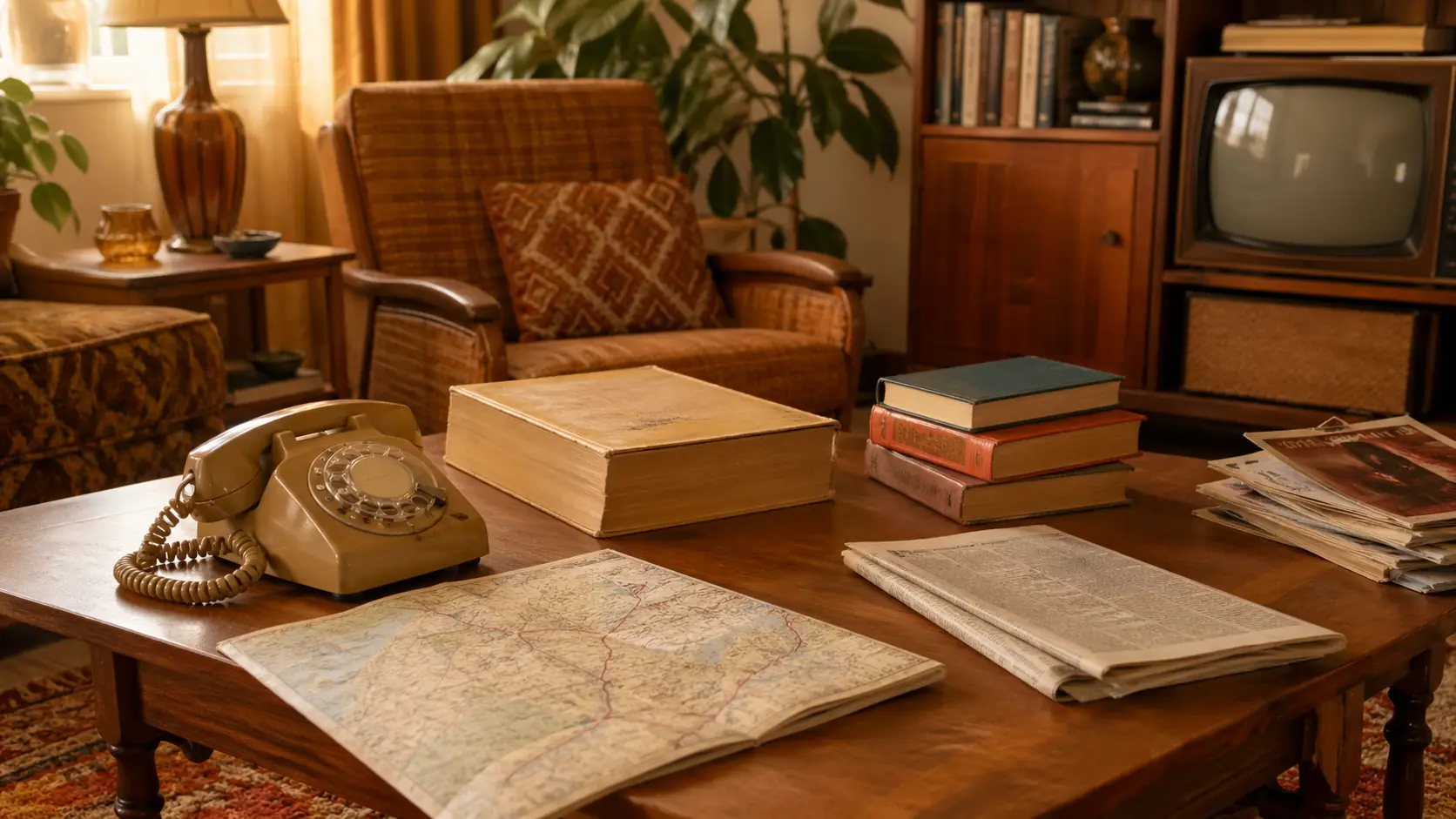
Today, finding something takes a few seconds. A restaurant, a song lyric, a phone number, a route, a movie time, the name of an actor you vaguely remember from childhood, all of it lives inside a little rectangle in your pocket.
But in the 1970s, finding things took effort.
You had to look. You had to ask. You had to wait. You had to flip pages, make calls, walk into buildings, unfold maps, read bulletin boards and sometimes rely on that one person in town who somehow knew everything.
Before the internet, information did not come to you. You went to it.
That is part of what makes the 70s so fascinating today. The decade gave us color television, home stereos, record stores, shopping malls, CB radio, paper catalogs and crowded libraries. But it was still a world where knowledge felt physical. It sat on shelves. It arrived in newspapers. It was printed in thick books. It was written on scraps of paper and pinned to cork boards. If you wanted to find something, you had to know where to begin.
The Phone Book Was the Original Search Engine

Before Google, there was the phone book.
Every home seemed to have one. Usually, it lived near the telephone, under a stack of papers or in a kitchen drawer that also held pens, coupons, batteries and mystery keys. The white pages helped you find people. The yellow pages helped you find businesses. Plumbers, doctors, record shops, diners, florists, electricians and taxi companies were all listed in one heavy book.
If you needed a number, you did not search it. You looked it up alphabetically.
The yellow pages were especially important. They were more than a directory. They were local advertising, local SEO and local discovery before those words existed. A bigger ad meant a better chance of being noticed. A bold listing could make a business feel more trustworthy. For many families, choosing a repairman or restaurant began with a finger moving slowly down a column of small print.
There was also a social side to it. If you could not find the number, you asked someone who might know. “Call your aunt.” “Ask the neighbor.” “Check the number on the fridge.” Information lived in people as much as it lived in books.
Libraries Were Where Questions Went to Become Answers

In the 70s, the library was not just a quiet place. It was one of the most powerful tools a person had.
Students went there for school reports. Adults went there to look up jobs, history, health topics, recipes, addresses, travel information and local records. Librarians were human search engines with patience, systems and a deep understanding of where things were hiding.
The card catalog was the gateway. Instead of typing keywords, you pulled open little wooden drawers filled with index cards. Each card pointed to a book, an author, a subject or a classification number. The process was slow, but it had its own rhythm. You searched, copied a number, walked into the stacks and hoped the book was actually there.
Reference sections were treasure rooms. Encyclopedias, dictionaries, atlases, almanacs and directories lined the shelves. A printed encyclopedia set could answer almost anything a child needed for homework, even if the information was already a few years old. Encyclopaedia Britannica had long been one of the most famous reference works, with print editions that shaped how generations encountered organized knowledge before digital access became normal.
There was something memorable about learning this way. You did not just find one answer. You often discovered five other things along the way.
Newspapers Told You What Was Happening
The daily newspaper was another essential tool.
It told you the weather, the movie listings, the sports scores, the TV schedule, the local events, the job openings, the obituaries, the sales and the headlines from around the world. If you wanted to know what was playing at the cinema, you checked the newspaper. If you wanted to buy a used car, you checked the classifieds. If you wanted to rent an apartment, find a yard sale or look for a job, the newspaper was often the first place to start.
The classified ads were a world of their own. Tiny lines of text carried big possibilities: furniture for sale, puppies available, rooms to rent, instruments wanted, part-time work, lost pets, estate sales, second-hand cars and community announcements.
There was no instant refresh. You waited for tomorrow’s edition. If you missed something, it was gone unless you kept the paper or went to a library archive.
In a strange way, that made information feel more important. People read carefully. They clipped articles. They circled ads. They folded pages and left them on kitchen tables.
Paper Maps Were the GPS

Getting somewhere in the 70s required trust, patience and sometimes a good sense of humor.
There were no smartphones giving turn-by-turn directions. No traffic alerts. No blue dot showing exactly where you were. Instead, people used paper maps, road atlases, gas station directions and handwritten notes. Rand McNally’s road atlases became part of American travel culture, with early editions dating back to the 1920s and paper road maps remaining essential long before GPS became everyday technology.
A family road trip usually involved someone in the passenger seat unfolding a map that never seemed to fold back the same way again. Routes were highlighted with pen. Exits were memorized. Landmarks mattered. Directions sounded like: “Turn left after the big church,” or “If you pass the diner, you’ve gone too far.”
Getting lost was part of the experience. Sometimes it led to arguments. Sometimes it led to unexpected discoveries: a roadside diner, a scenic route, a strange little town or a motel with a flickering sign.
Today, navigation is more efficient. But it is also less adventurous.
Catalogs Were Shopping Before Scrolling

Before online shopping, people browsed catalogs.
The Sears catalog is one of the most famous examples. For much of the 20th century, it brought a huge range of products into people’s homes through printed pages. Sears eventually closed its catalog division in 1993, ending one of the great mail-order traditions in American retail.
In the 70s, catalogs were not just practical. They were entertainment. Children circled toys before Christmas. Parents compared appliances, clothes, furniture and tools. People dreamed through catalogs long before they clicked “add to cart.”
There was a ritual to it. You sat at the table or on the living room floor and turned page after page. You marked what you wanted. You filled out forms. You mailed orders or called them in. Then you waited.
That waiting made the object feel bigger when it arrived. A package was not just a delivery. It was the end of a little story.
Word of Mouth Still Mattered
A lot of things were found simply by asking.
Need a mechanic? Ask your brother-in-law. Need a babysitter? Ask the neighbor. Want to know which band is playing this weekend? Ask someone at school, the record store or the local diner. Looking for a good restaurant? Listen to what people say after church, at work or over the fence.
Word of mouth was powerful because communities were more local. People often shopped in the same places, read the same local paper, listened to the same radio stations and recognized the same names. Reputation traveled slowly, but it traveled deeply.
A good recommendation meant something. A bad reputation could follow a business for years.
Radio Helped People Discover What Was New
Radio was not only for music. It was also a discovery tool.
Local stations announced concerts, contests, traffic, weather, school closings, community events and breaking news. DJs were trusted voices. They introduced songs, promoted local happenings and shaped taste. If a new single was becoming popular, many people heard it first through the radio, not through a search bar or algorithm.
The same applied to television. Commercials, local news segments and talk shows helped people discover products, events, movies and trends. You learned what was happening by being tuned in at the right moment.
If you missed it, you missed it.
That gave pop culture a different rhythm. Everyone did not discover everything at once. Information spread through waves: radio, TV, newspapers, friends, schoolyards, offices and record shops.
Bulletin Boards Were Local Social Media

Community bulletin boards were everywhere.
They appeared in grocery stores, churches, libraries, schools, laundromats, college campuses and local shops. They carried handwritten notes, typed flyers, babysitting offers, guitar lessons, lost dog notices, garage sale signs, apartment rentals and band announcements.
A bulletin board was simple, but effective. It was local. It was physical. It required people to stand there and read.
In some ways, it was the social feed of its day. Only instead of scrolling, you stood in front of cork and paper, reading what your town had to say.
Record Stores, Bookstores and Shops Were Information Hubs
Specialty shops mattered because the people behind the counter knew things.
A record store clerk could tell you what was new, what was popular, what was weird, what was worth buying and what just came in from another city. A bookstore owner could recommend authors. A camera shop could explain film. A hardware store could help solve a household problem better than any printed manual.
These places were not just stores. They were knowledge centers.
That is one reason so many people feel nostalgic for them. Finding something was often connected to a conversation. You did not simply receive information. You built a relationship with the person who had it.
Finding Things Took Longer, But Maybe We Remembered More
The 70s were not easier. Finding information could be frustrating. You could waste hours looking for a number, a book, a street, a product or a song title. You could get bad directions. You could miss the movie time. You could wait weeks for a catalog order only to discover the item was out of stock.
But the process made information feel earned.
People remembered phone numbers. They memorized routes. They kept address books. They clipped recipes. They saved maps. They wrote things down. They asked questions face to face. They trusted librarians, clerks, neighbors, DJs and newspapers.
Today, we have more information than anyone in the 70s could have imagined. But it often disappears as quickly as it appears. We search, skim, click and forget.
In the 70s, finding something took longer. But sometimes, that made the answer stick.
The Final Page
Before the internet, life had more friction. You could not instantly check everything. You had to be resourceful. You had to wait. You had to talk to people. You had to know which book, which counter, which page, which shop or which person might have the answer.
That world was slower, but it was not empty. It was full of systems. Phone books, libraries, maps, catalogs, newspapers, radio stations, bulletin boards and people all helped connect the dots.
Maybe that is why this part of 70s life feels so nostalgic now. It reminds us of a time when finding something was not just a search.
It was a small adventure.
