
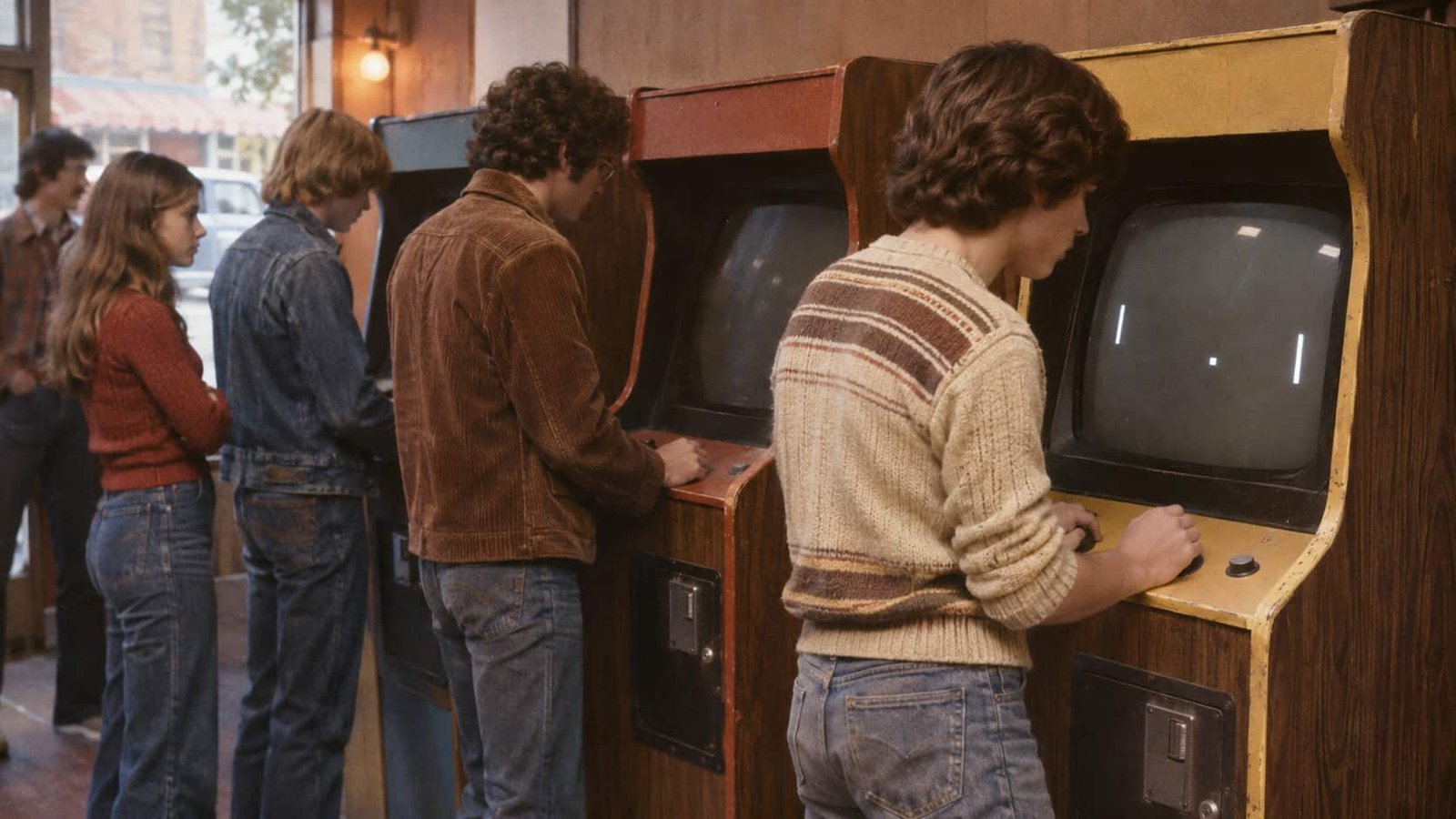
In the 1970s, you could steer a rocket with four buttons, aim a torpedo through a periscope or play football by spinning a trackball. Those were all coin-operated video games. The cabinets were part of the experience, from the two knobs on Pong to the throttle lever on Lunar Lander.
These 15 classic arcade games are ordered by their original arcade release year. Each entry describes a period cabinet, the controls you would put your hands on and what you could do to put points on the screen. Some games came in several cabinet styles, so the descriptions name the version where that affects how it played.
1971–1975 arcade games
1. Computer Space (1971)
Nutting Associates sold the original one-player Computer Space in a curved fiberglass cabinet with a glitter finish. Two buttons turned the rocket, a third gave it thrust and a fourth fired. On screen, two saucers shot back while the rocket drifted through a sparse star field.
Each saucer hit earned a point. The trick was to use short bursts of thrust so you could adjust your aim without drifting into incoming fire. Outscore the saucers in 99 seconds and the machine gave you another round.
2. Pong (1972)
Atari’s upright Pong had two rotary knobs under the screen. Two players stood shoulder to shoulder, each turning a knob to slide a white paddle up or down. The ball bounced between them and off the top and bottom edges of the court.
A missed return gave the other player a point. Move your paddle to meet the ball near one end of it and you can send it back at a steeper angle. That makes the other player cover more of the screen on the next shot.
3. Space Race (1973)
Atari made wooden and fiberglass uprights for this two-player race. Each player had a two-way joystick to move a rocket up or down. The goal was to get from the bottom of the screen to the top while small asteroids streamed across the field.
Every completed trip added one point. A collision put your rocket back at the bottom after a brief delay. Watch for a gap before you push forward. A short wait can cost less time than starting the whole climb again.
4. Gran Trak 10 (1974)
Atari built a steering wheel, gearshift, accelerator and brake into the Gran Trak 10 driving cabinet. The monitor showed the whole course from overhead. A small car followed the route between white roadside markers, with dark oil slicks that took away your steering for a moment.
You earned points for distance and had to pass checkpoints in sequence before the timer ran out. Brake before tight turns to keep from spinning out on the markers. A clean stretch through the corners leaves more time to add distance.
5. Tank (1974)
The Kee Games cabinet gave each player a pair of joysticks. Each stick operated one tread. Moving both together drove the tank forward or back, and working them separately turned it. A fire button let you take a shot through the block maze.
The scoreboard rewarded hits on the other tank, and driving into a mine handed your opponent a point. Look for the small Xs that mark the mines. Set up at the mouth of a clear lane so your opponent has to turn before firing back.
6. Gun Fight (1975)
Midway put two pairs of joysticks on the front of its Western-themed upright. Each player used one stick to walk a gunfighter and the other to aim and fire. The duel played out across the screen, with obstacles such as cacti and a covered wagon between the two figures.
Hit your opponent to score. A clean shot depends on where your gunfighter is standing and what sits in the path of the bullet. Move to a clear line of fire, take the shot and use the obstacles to cover your next move.
1976–1977 arcade games
7. Breakout (1976)
The upright Atari cabinet had a rotary knob and a serve button. Turn the knob and your paddle moves across the bottom of the screen, ready to return a ball toward a wall of bricks. The rows got their colors from an overlay on a black-and-white display.
Use the ends of the paddle to angle the ball toward a narrow channel through the wall. Once it slips behind the bricks, it can hit several in quick succession. Keep an eye on where it will come back down so you’re ready for the next return.
8. Night Driver (1976)
Atari sold Night Driver in upright and sit-down versions, with a steering wheel, gearshift and a single accelerator pedal. White posts appeared to rush toward you from the darkness. A car graphic fixed near the bottom of the screen gave you a reference point for the road ahead.
The aim was to cover ground before time ran out. Follow the line of posts further up the screen to anticipate bends. Easing off the pedal before a tight corner gives you time to steer and avoid a crash that eats into your run.
9. Sea Wolf (1976)
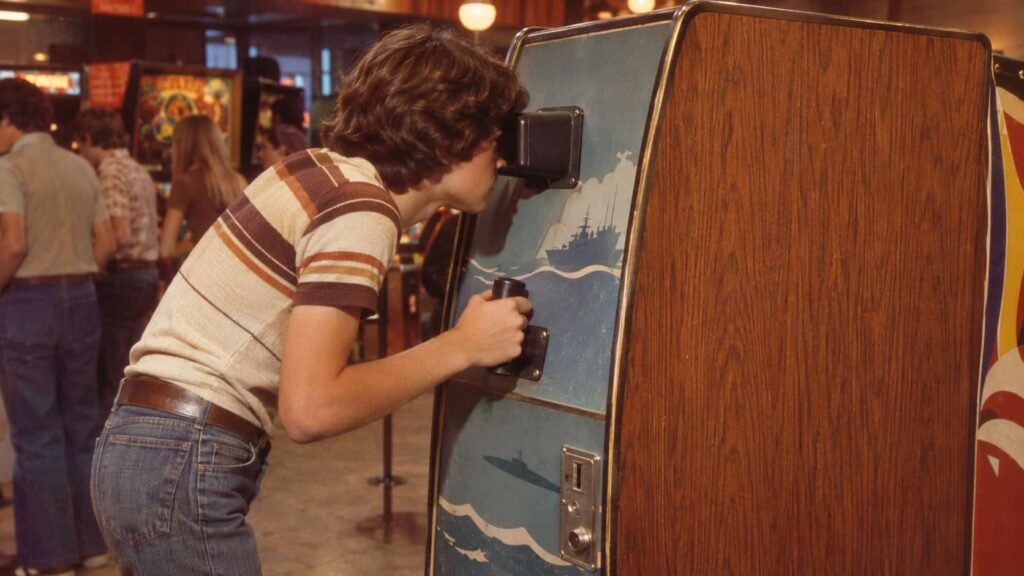
Midway built a swiveling periscope into the front of its upright Sea Wolf cabinet. You looked through the viewer to see the crosshair and the moving ships. A thumb button on the right handle fired a torpedo. After five shots, the viewer signaled a brief reload.
Aim ahead of a moving ship so it reaches the crosshair as the torpedo arrives. Leave room for the reload when choosing your shots. Firing at the first hull you see can leave you waiting to reload while an easier target crosses the screen.
10. Space Wars (1977)
The Cinematronics upright put two sets of buttons below a sharp vector display. Each player could rotate, thrust, fire and jump into hyperspace. The cabinet also let players change options such as gravity and inertia, which affected how the ships moved across the screen.
You won exchanges by getting a shot onto the other ship. With inertia enabled, start turning while you still have room to swing around. A little distance gives you time to set up another pass if your opponent’s first shot damages your ship.
1978–1979 arcade games
11. Space Invaders (1978)
Taito released Space Invaders in Japan in 1978, and Midway brought it to North America. A Midway upright had buttons for moving a laser cannon left or right and firing upward. Rows of aliens marched above a line of shelters, which wore away as the battle went on.
The advancing ranks moved faster as you picked them off. Keep a clear lane beside a shelter so you can shoot and duck back under cover. A passing saucer offered bonus points when you had time to line up a shot.
12. Atari Football (1978)
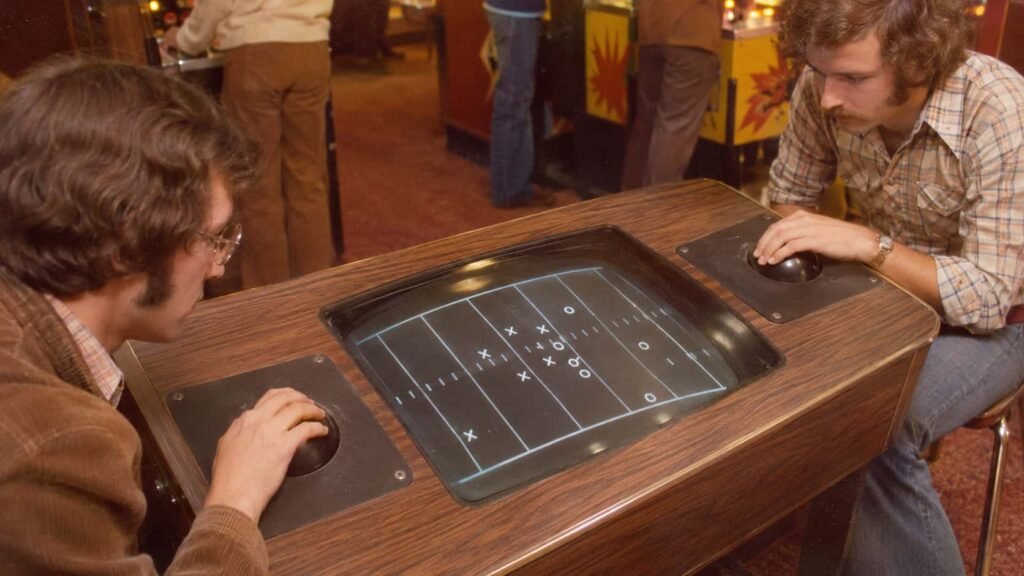
The two-player Atari Football cabinet was a flat tabletop with a player at each end. Its black-and-white display showed the teams as Xs and Os. Choose an offensive or defensive play on the control panel, then roll the trackball to move the player under your control.
On offense, watch the formation open up and roll toward a gap to gain yards. Get the ball into the end zone for a touchdown. On defense, steer into the ball carrier’s path to make the tackle.
13. Lunar Lander (1979)
Atari’s upright Lunar Lander used a black-and-white vector display to draw the lunar surface and the outline of a landing craft. Two buttons rotated the craft and a lever controlled the strength of the engine. The screen showed your fuel and your horizontal and vertical speeds.
Landing pads carried different score multipliers. Pick one you can reach with the fuel you have left, correct your sideways drift and get upright before touchdown. Save enough thrust to slow the final descent. A high-value pad pays off only when you can land on it.
14. Galaxian (1979)
Namco released Galaxian in 1979. Midway’s licensed upright put a left-right control and a fire button below a color screen. The player moved a small ship along the bottom and fired up at the formation. Aliens peeled away from the ranks, diving toward the ship and dropping bombs.
The aliens’ colors indicated their rank and point values. Watch for the high-ranking ships near the top as they come down with escorts. Keep space to slide sideways and dodge a diving attack while you line up your shot.
15. Asteroids (1979)
Atari’s upright Asteroids drew the ship and drifting rocks as bright outlines on a black vector screen. Five buttons turned the ship left or right, applied thrust, fired or sent it into hyperspace. Large rocks broke into smaller pieces when hit, and flying saucers added another line of fire to watch.
Clear a few fragments before breaking the next large rock. Fewer small targets make it easier to see a way out. With room to drift and turn, you can aim at the next threat before it crosses your path.
Recognizing the original cabinets
If you come across a cabinet at an arcade or a museum, look at the control panel first. The periscope, trackballs and throttle lever are as distinctive as the games on their screens. The cabinet photos and original flyers in the sources show details such as the two-player layout on Atari Football and the artwork on Midway’s Galaxian.
The same years brought plenty to play at home. Revisit classic 1970s board games or see which 70s toys you remember.
Sources
- The Strong National Museum of Play — Computer Space
- The Strong National Museum of Play — Pong
- International Arcade Museum — Space Race
- International Arcade Museum — Gran Trak 10
- International Arcade Museum — Tank
- International Arcade Museum — Gun Fight
- The Strong National Museum of Play — Gun Fight cabinet
- International Arcade Museum — Breakout
- International Arcade Museum — Night Driver
- International Arcade Museum — Sea Wolf
- International Arcade Museum — Space Wars
- The Strong National Museum of Play — Space Invaders
- International Arcade Museum — Atari Football
- Arcade History — Atari Football two-player model
- International Arcade Museum — Lunar Lander
- The Arcade Flyer Archive — Namco’s 1979 Galaxian flyer
- The Arcade Flyer Archive — Midway’s Galaxian cabinet flyer
- U.S. International Trade Commission — Galaxian cabinet and gameplay description (PDF)
- The Strong National Museum of Play — Asteroids
