
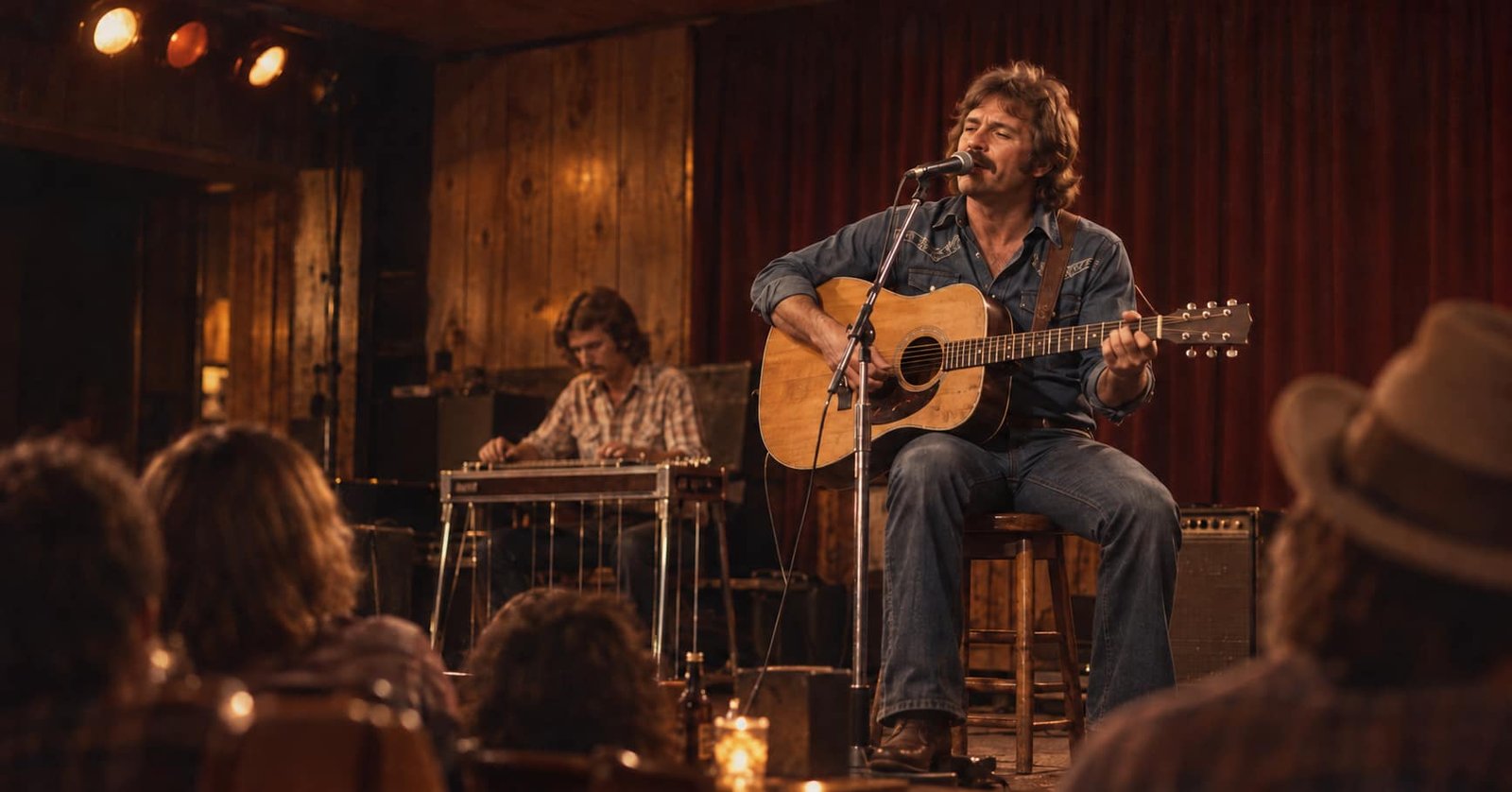
The best 70s country songs cover a lot of ground: Dolly Parton’s urgent Jolene, John Denver’s homesick Take Me Home, Country Roads and Kenny Rogers’s storytelling in The Gambler are just the beginning. The decade also gave us beautifully judged heartbreak, comic tales from the road and duets that sounded like conversations between old friends.
These 35 favourites bring together traditional country, outlaw voices, country-rock and the country-pop records that reached a wider radio audience. Each song has a Spotify link and a YouTube link, so you can revisit the familiar ones and discover a few you may not have heard for years.
The years identify the 70s single or album releases discussed here. Streaming services may show a later compilation or remaster date. Where a YouTube link features a later live performance, it is labelled accordingly.
Jump to: Familiar classics · Great country voices · Nashville and outlaw country · Road songs and crossovers · Duets and ballads
Familiar 70s country classics
A few recognisable opening bars can bring an entire record back. These seven songs make a welcoming start, moving between singalongs, ambition, affection and a very unusual car.
1. John Denver — Take Me Home, Country Roads (1971)
The strummed opening and welcoming chorus make this one of the easiest ways into 70s country. Denver’s voice carries the pull of a place remembered from afar, even for listeners who have never visited West Virginia. It brings the warmth of folk singing to a room-sized singalong.
Listen on Spotify · Listen on YouTube
2. Dolly Parton — Jolene (1973)
Parton makes a plea sound urgent without turning it into an accusation. The repeating guitar figure keeps the tension close, while her voice moves between admiration and fear. Released as a single in 1973, Jolene also became the title track of her 1974 album.
Listen on Spotify · Listen on YouTube
3. Kenny Rogers — The Gambler (1978)
Don Schlitz’s story of a train journey and an encounter with an older gambler gives Rogers a character to inhabit. His unhurried delivery lets the advice arrive naturally, then the chorus makes it memorable. It is country storytelling with a whole scene contained inside the song.
Listen on Spotify · Listen on YouTube
4. Glen Campbell — Rhinestone Cowboy (1975)
Beneath the shining arrangement is a story about ambition, disappointment and the determination to keep going. Campbell gives it enough weariness to make the optimism convincing. The big chorus captures the appeal of 70s country-pop: an accessible melody with a recognisably human struggle underneath.
Listen on Spotify · Listen on YouTube
5. Lynn Anderson — Rose Garden (1970)
The strings are bright, but Anderson’s vocal is firm about the limits of romantic promises. That balance gives Rose Garden more character than a simple feel-good song. Its brisk pace also makes it a lively companion to the slower heartbreak records in this selection.
Listen on Spotify · Listen on YouTube
6. Charley Pride — Kiss an Angel Good Mornin’ (1971)
Pride sounds relaxed and completely at home in this compact, affectionate record. A gentle bounce in the accompaniment gives his warm voice room to lead. The song offers a cheerful counterweight to country’s troubled relationships, finding its pleasure in a small, everyday expression of love.
Listen on Spotify · Listen on YouTube
7. Johnny Cash — One Piece at a Time (1976)
Cash plays a factory worker whose plan to build a car from gradually collected parts becomes increasingly absurd. His straight-faced delivery makes the joke work, with each new detail creating another problem. It is a reminder that 70s country could tell a wonderfully funny story too.
Listen on Spotify · Listen on YouTube
Great country voices and unforgettable stories
The settings are often ordinary, but the singing makes each situation feel personal. Listen for the different ways these performers handle memory, loneliness and the difficulty of saying goodbye.
8. Loretta Lynn — Coal Miner’s Daughter (1970)
Lynn turns memories of her Kentucky upbringing into a portrait of family pride, hard work and limited means. The household details give the song its weight, while her clear delivery keeps it personal. Hearing her sing her own story is a large part of its lasting appeal.
Listen on Spotify · Listen on YouTube
9. Tanya Tucker — Delta Dawn (1972)
Tucker was only thirteen when she recorded this haunting story, but her vocal already had an arresting confidence. The contrast between the young singer and the troubled character makes Delta Dawn memorable. The arrangement gradually opens around a chorus that is difficult to forget.
Listen on Spotify · Listen on YouTube
10. Conway Twitty — Hello Darlin’ (1970)
A spoken greeting makes the listener feel as though they have walked into a private reunion. Twitty then lets regret take over, with his deep voice doing much of the emotional work. The restraint matters: the character is trying to remain composed while old feelings return.
Listen on Spotify · Listen on YouTube
11. George Jones — The Grand Tour (1974)
An ordinary walk through a home becomes an account of everything that has gone wrong. Jones gives the domestic details a devastating weight, stretching a phrase without losing the conversational thread. Listen to how much meaning he places in the spaces between the words.
Listen on Spotify · Listen on YouTube
12. Tammy Wynette — ‘Til I Can Make It on My Own (1976)
Wynette captures an uneasy stage between separation and independence: the decision has been made, but the need for comfort remains. Her voice makes that contradiction believable. The measured arrangement leaves room for vulnerability, giving the song an emotional complexity that outlasts its immediate situation.
Listen on Spotify · Listen on YouTube
13. Sammi Smith — Help Me Make It Through the Night (1970)
Kris Kristofferson’s song becomes especially intimate in Smith’s smoky, understated delivery. The arrangement stays soft around a direct request for companionship, allowing the vulnerability to remain in the foreground. Her 1970 recording is a good example of how a singer can make someone else’s writing feel deeply personal.
Listen on Spotify · Listen on YouTube
14. Dolly Parton — I Will Always Love You (1974)
Parton’s 1974 recording keeps the farewell tender and unusually generous. Written for her professional parting from Porter Wagoner, the song holds gratitude and the need to leave in the same thought. The quieter scale of this original version makes every change in her voice count.
Listen on Spotify · Listen on YouTube
From Nashville polish to outlaw country
The decade had room for both sparse arrangements and sweeping productions. This stretch brings contrasting voices together, from Willie Nelson’s relaxed phrasing to Charlie Rich’s elegant country-pop.
15. Willie Nelson — Blue Eyes Crying in the Rain (1975)
The spare setting on Red Headed Stranger leaves very little between Nelson and the listener. His phrasing makes an older country song feel immediate, with the guitar answering rather than crowding the vocal. This 1975 recording is a fine place to hear the expressive power of his timing.
Listen on Spotify · Listen on YouTube
16. Waylon Jennings & Willie Nelson — Good Hearted Woman (1976)
Jennings and Nelson bring different kinds of roughness to a song about affection, difficult behaviour and long-suffering loyalty. Their duet has a relaxed, companionable energy. The version associated with 1976’s Wanted! The Outlaws helped give their musical partnership a recognisable sound of its own.
Listen on Spotify · Listen on YouTube
17. Waylon Jennings — Luckenbach, Texas (Back to the Basics of Love) (1977)
Jennings’s low voice and the easy rhythm make the wish for a simpler life feel inviting. The record has space to breathe, with the chorus settling in rather than demanding attention. It is a natural next listen after Good Hearted Woman, showing another side of the same country world.
Listen on Spotify · Watch live on YouTube
18. Waylon Jennings & Willie Nelson — Mammas Don’t Let Your Babies Grow Up to Be Cowboys (1978)
The title promises advice, but the appeal is in the affection beneath it. Jennings and Nelson share the story with enough ease to make the cowboy’s restless life sound both troublesome and attractive. Their 1978 recording turns a cautionary idea into a remarkably comfortable singalong.
Listen on Spotify · Listen on YouTube
19. Merle Haggard — If We Make It Through December (1973)
A laid-off worker worries about providing for his family while trying to hold on to the possibility of better days. Haggard keeps the feeling grounded in the character’s immediate concerns. Although December gives the song its setting, its anxiety and guarded hope reach well beyond Christmas.
Listen on Spotify · Listen on YouTube
20. Charlie Rich — The Most Beautiful Girl (1973)
Rich’s warm, slightly weathered voice sits inside an elegant arrangement of piano, strings and a steady rhythm. The polished surface never quite hides the narrator’s regret. It captures the softer country-pop sound of the decade, where an intimate plea could also become a broad radio favourite.
Listen on Spotify · Listen on YouTube
21. Don Williams — Tulsa Time (1978)
Williams’s unforced delivery makes Tulsa Time feel easy from the first few bars. The firm rhythm and distinctive guitar figure give the song its momentum, while the voice remains calm above them. It is a good reminder that a country record can move without sounding hurried.
Listen on Spotify · Listen on YouTube
Road songs, country-rock and crossover favourites
The pace picks up with guitar grooves, trucking stories and a fiddle contest. Gentler crossovers then add a change of mood before another bright Glen Campbell favourite.
22. Jerry Reed — Amos Moses (1970)
Reed combines a comic bayou story with a clipped, funky rhythm that sounds quite different from the smoother Nashville records here. His vocal is almost another percussion part. The pleasure is in the performance as much as the plot: listen to how sharply he fits each phrase into the groove.
Listen on Spotify · Listen on YouTube
23. Jerry Reed — East Bound and Down (1977)
Closely tied to Smokey and the Bandit, this brisk trucking song carries the forward motion of the film into the recording. Reed’s quick delivery and the busy instrumental backing barely pause. Put it beside Convoy for two very different examples of the decade’s fascination with life on the road.
Listen on Spotify · Listen on YouTube
24. C.W. McCall — Convoy (1975)
CB-radio exchanges turn a fictional truck journey into a miniature action story. McCall’s spoken delivery lets the characters and their jargon do much of the work, with the chorus providing a familiar return point. Few records place the listener so directly inside a particular piece of 70s culture.
Listen on Spotify · Listen on YouTube
25. The Charlie Daniels Band — The Devil Went Down to Georgia (1979)
A fiddle contest gives the band a story and an excuse to demonstrate its musical firepower. The spoken passages build anticipation, then the instrumental bursts supply the confrontation. Released near the end of the decade, it adds a forceful country-rock sound to the selection.
Listen on Spotify · Listen on YouTube
26. The Bellamy Brothers — Let Your Love Flow (1976)
The Bellamy Brothers bring a light touch to a melody that seems designed for an open window and a long drive. The arrangement is smooth without losing its rhythmic lift. This country-pop crossover fits the sunny side of the decade, especially alongside Southern Nights.
Listen on Spotify · Listen on YouTube
27. Freddy Fender — Before the Next Teardrop Falls (1975)
Fender moves between English and Spanish without disturbing the song’s gentle flow. His vocal makes a generous promise sound natural, with a slight ache underneath the warmth. The 1975 hit gives this selection another musical perspective, drawing country and his Tex-Mex background together.
Listen on Spotify · Listen on YouTube
28. Glen Campbell — Southern Nights (1977)
Campbell gives Allen Toussaint’s song a bright, tightly moving country-pop arrangement. The guitar figure is as inviting as the chorus, helping the record feel lively without becoming heavy. It pairs well with Rhinestone Cowboy, but replaces that song’s hard-won ambition with a much sunnier mood.
Listen on Spotify · Listen on YouTube
Heartbreak, duets and songs to sing along with
The final selections move through chance encounters, polished ballads and playful duets. Two very different voices, Johnny Cash and John Denver, bring the listening journey to a close.
29. Kenny Rogers — Lucille (1977)
Rogers begins with what seems like a chance encounter, then lets another person’s broken family change the meaning of the scene. His conversational voice keeps the story clear as the mood darkens. The chorus is memorable, but the quietly unfolding situation gives the record its staying power.
Listen on Spotify · Listen on YouTube
30. Crystal Gayle — Don’t It Make My Brown Eyes Blue (1977)
Gayle’s smooth voice and the distinctive piano figure make the record recognisable almost immediately. The sadness stays understated, with a lightly swinging arrangement keeping it from becoming a heavy ballad. It is one of the decade’s clearest meetings between country phrasing and a polished pop sound.
Listen on Spotify · Listen on YouTube
31. Olivia Newton-John — If You Love Me (Let Me Know) (1974)
Before Grease became part of her story, Newton-John had a successful country-pop period of her own. This recording balances her light vocal with a noticeably deeper backing voice and an easy-moving rhythm. It belongs to the crossover side of 70s country, alongside the more traditional sounds in this list.
Listen on Spotify · Listen on YouTube
32. Emmylou Harris — Two More Bottles of Wine (1978)
Harris gives Delbert McClinton’s song a brisk, spirited performance, with the band keeping a firm pulse beneath the story. Her voice stays clear even when the arrangement gets busy. This is a useful first listen for anyone who knows her mainly through gentler ballads and harmonies.
Listen on Spotify · Listen on YouTube
33. Conway Twitty & Loretta Lynn — Louisiana Woman, Mississippi Man (1973)
Twitty and Lynn turn distance into a playful exchange between two strong characters. Their contrasting voices make the attraction feel conversational, and neither singer disappears into the duet. The lively rhythm brings a welcome change after several of the decade’s more troubled love stories.
Listen on Spotify · Listen on YouTube
34. Johnny Cash — Sunday Morning Coming Down (1970)
Cash gives Kristofferson’s picture of a lonely Sunday morning a weary, lived-in gravity. Small details build the character’s isolation without requiring a dramatic plot. The 1970 performance is worth hearing for the way he lets an ordinary scene carry such a strong emotional weight.
Listen on Spotify · Listen to the 1970 recording on YouTube
35. John Denver — Annie’s Song (1974)
A gently swaying melody gives Denver room for an unusually open expression of affection. The arrangement grows around his voice without taking attention away from it. After the difficult relationships and restless journeys elsewhere in this list, Annie’s Song offers a warm, unguarded place to finish.
Listen on Spotify · Listen on YouTube
Why 70s country had so many different sounds
Listen to Blue Eyes Crying in the Rain beside The Most Beautiful Girl and the range becomes clear. One leaves generous space around the voice and guitar; the other surrounds the singer with a much fuller production. Both depend on a performance that makes the situation believable.
That variety is part of the pleasure of revisiting the decade. A country playlist can move from the family memories of Coal Miner’s Daughter to the energy of East Bound and Down, then settle into Annie’s Song. The connections are in the voices, the details and the melodies people carry with them.
Questions about these 70s country songs
Why include John Denver and Olivia Newton-John?
Both belong to the decade’s country crossover story, even though their audiences and musical styles also reached into folk and pop. Newton-John was named the Country Music Association’s Female Vocalist of the Year in 1974. Including that side of the music gives a fuller picture of what listeners heard during the decade.
Were all these songs first written in the 1970s?
The focus is on the performers’ 70s recordings, rather than the date each song was written. Nelson’s Blue Eyes Crying in the Rain revisits an older country composition. Good Hearted Woman also had an earlier Jennings solo version before the Jennings–Nelson duet associated with Wanted! The Outlaws. The dates help distinguish those versions.
How should I build a playlist from the selection?
For a lively opening, try Southern Nights, Tulsa Time and East Bound and Down. Bring in story songs such as The Gambler between faster records so the words have room to register. For a quieter finish, I Will Always Love You and Annie’s Song make a warm pairing.
Keep exploring the music of the 70s
For more music beyond country, explore our 100 best 70s songs. If the gentler tracks are your favourites, continue with our 70s love songs for weddings and slow dancing.
Remember the voices as well as the songs? Test your knowledge of the decade’s singers, bands and albums in our 70s Music Quiz.
Listening note: links lead to artist recordings, catalogue releases and selected official performances. Original releases, remasters and compilation editions may have different running times. Availability can vary by country.
