

A school day in 1970s America could begin on a yellow bus and end with homework copied from a chalkboard. In between, you might work through a purple worksheet, watch a filmstrip, eat a hot lunch and head out for recess. Picture a day at an American public elementary school around 1975, reconstructed from school records, newspaper menus and classroom materials from several communities.
Before the First Bell
At the bus stop, you might already be holding the lunch box you would open hours later. Children who lived nearby could walk to school and meet the bus riders at the door. At a participating school, a pupil might stop for breakfast before class. The federal School Breakfast Program became permanent in 1975. In the classroom, coats went on hooks, pencils came out and the teacher called names for attendance.
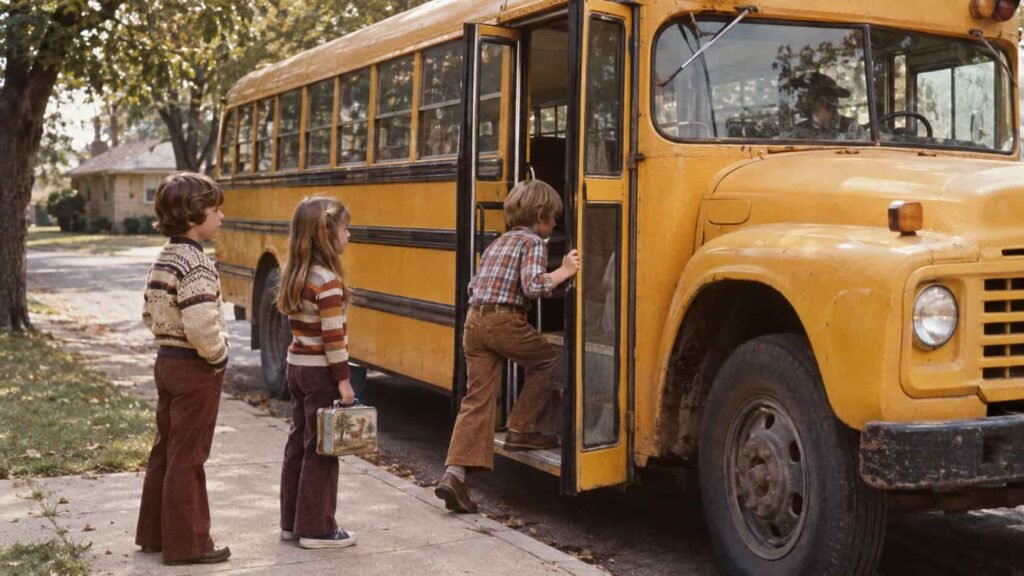
In Boston, a federal judge ordered the public schools to begin busing pupils between predominantly Black and predominantly white areas in September 1974 as part of school desegregation. For some Boston children, a new school assignment took them across neighborhood lines.
Chalkboard Lessons, Cursive and Purple Worksheets
A math lesson could unfold one line at a time. The teacher worked an example in chalk, then gave you a problem to try at your desk. You could look up at the board to check where to put the remainder. Spelling might send you back to your notebook, copying the week’s words and leaving room to write each one again from memory.
Handwriting had its own books. Georgia’s 1976 textbook list included Zaner-Bloser’s Creative Growth with Handwriting, with separate third-grade books for the transition to cursive and for cursive practice, both dated 1975. A practice sheet might give you ruled lines for getting the height of a letter right before you tried joining it to the next one.
The next worksheet to land on your desk might have purple print. A spirit duplicator, often called a Ditto machine, used a solvent to transfer dye from a prepared master onto each copy. Purple was a common color for those copies. A teacher could run a class set of spelling exercises or arithmetic problems from the same master and pass the stack down the rows.
Measuring in Centimeters
A measurement lesson could put a paper clip and a book beside the ruler. In 1975, the California State Department of Education published a guide for teaching metric measurement from kindergarten through eighth grade. One exercise asked pupils to estimate the width of a paper clip, the thickness of a book and even their own height in centimeters before checking the measurements.
Another exercise asked children to gather objects they guessed were one, two or three centimeters long and record the actual sizes. The chart had separate columns for the estimate and the measurement. A child could see where a guess was close, then try it again with the next object.
A Different Classroom in Hartford
Waverly Elementary School in Hartford, Connecticut, had an open education program, one of the American examples covered in a 1974 Educational Research Service review. The review described the wider approach as making room for different learning needs through more flexible classroom work. In that kind of room, a child might work through an activity independently while a teacher helped a small group nearby.
Congress passed the Education for All Handicapped Children Act in 1975. The law required states receiving federal assistance under the act to make a free appropriate public education available to eligible children with disabilities. It set deadlines in 1978 and 1980 for different age groups.
When the Room Went Dark
A filmstrip lesson could start with someone pulling the shades. The projector showed a sequence of still pictures, one frame at a time. A record or cassette could supply the narration. On a setup with manual advance, a beep in the recording told the teacher when to move to the next frame. The pause gave the class a moment to look closely or answer a question about what was on the screen.
An overhead projector could also bring a diagram or map onto the screen. The teacher could mark a clear transparency while facing the room, tracing a line or circling a place as the class watched. Pupils in the back row could follow the same map from their desks.
What Was on the School Lunch Tray in 1975?
At lunch, a sandwich brought from home could sit beside a tray from the cafeteria. The box it came in might say something about what you liked to watch after school. One example in the Smithsonian’s collection is a metal Kung Fu lunch box made by Thermos in 1974. Its television artwork would have been recognizable from across the table.
In Sandy, Oregon, the Sandy Post printed the school menu for the week of April 28, 1975. The paper gave families a day-by-day look at what the kitchen planned to serve.
| Date in 1975 | Lunch listed in the Sandy Post |
|---|---|
| Tuesday, April 29 | Hot dogs with ketchup, hash browns, carrots, apple crisp and milk |
| Wednesday, April 30 | Spanish rice with buttered corn and cornbread, orange wedges and milk |
| Thursday, May 1 | Tacos with green beans and applesauce, May Day cake and milk |
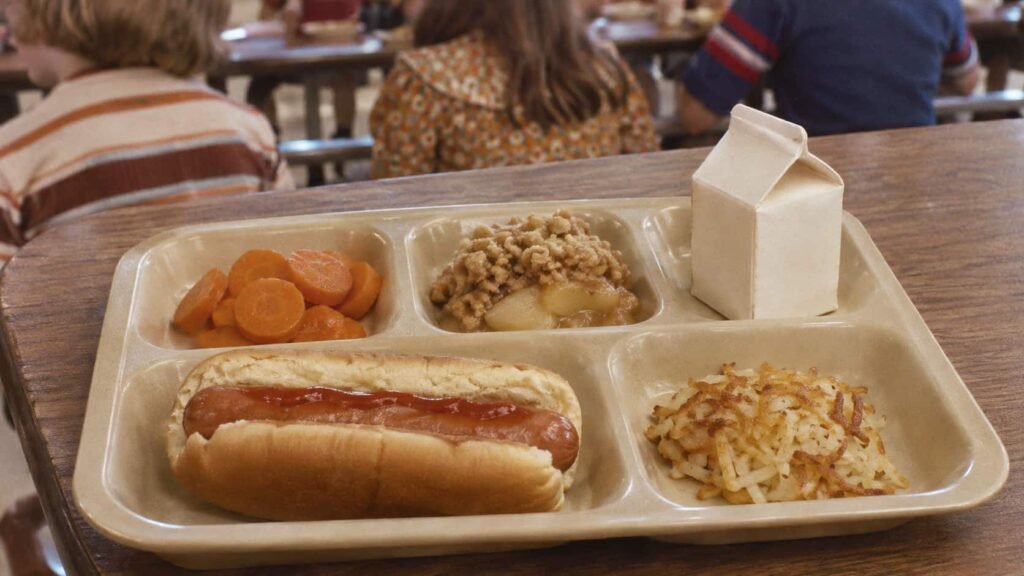
In Mesquite, Texas, the Mesquite Daily News listed a 55¢ elementary school plate lunch for that same week. The menu included chicken-fried beef patties and mentioned rolls and buns made at school.
In 1970, Congress required national income-based eligibility guidelines for free and reduced-price school meals. At a participating school, a child could qualify for a free or lower-priced lunch based on household income. Congress changed the thresholds several times during the decade.
Recess and Gym Class
Outside, there might be room to start a ball game, jump rope or climb on the playground equipment. A photograph from the 1974–75 school year shows elementary pupils on the playground of the Jacksonville State University laboratory school in Alabama.
A Timed Shuttle Run
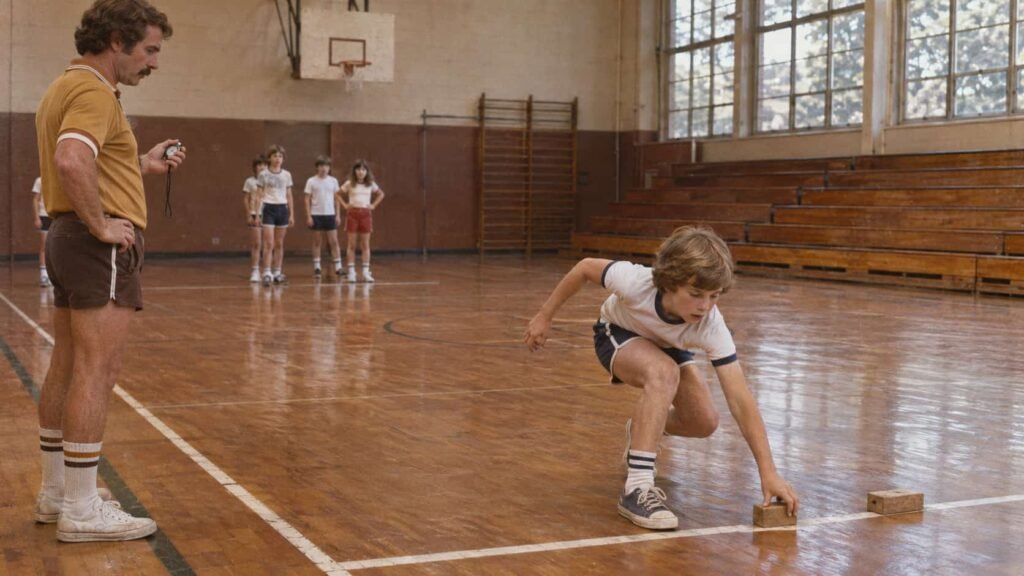
A school using the 1975 AAHPER Youth Fitness Test could set up a shuttle run with two lines 30 feet apart and two blocks at the far end. The pupil ran out, brought the first block back to the starting line and turned around for the second. A stopwatch timed the whole run.
The manual allowed two tries with a rest between them. The score was the quicker time, recorded to a tenth of a second. Sit-ups and the standing broad jump were also part of the test.
Back Inside for the Afternoon
Back at your desk, the afternoon might bring a drawing to finish or a few pages to read aloud. A library visit could send you to a drawer of catalog cards to find a book. You copied its call number before looking for the right shelf, and a date stamped on the book’s slip told you when to bring it back.
The Last Bell
Before dismissal, the teacher might write the next assignment on the board. You copied the page number into your notebook or tucked a worksheet into a textbook. A permission slip for a parent to sign could go in the same book. Then the walkers headed out, the bus riders lined up, and that folded slip still had to make it all the way home.
For more of the hours outside the classroom, revisit 10 Toys Every 70s Kid Remembers and how people found things before the internet.
Sources
- USDA Economic Research Service, history of the National School Lunch and School Breakfast Programs
- U.S. Department of Justice, Boston’s court-ordered school desegregation and busing in 1974
- Digital Library of Georgia, Georgia’s 1976 textbook list for elementary and high schools
- University of Illinois Library, spirit duplicators and classroom copies
- University at Buffalo Libraries, sound filmstrips and their advance cues
- Medical Teacher, “Use an overhead projector,” 1979
- Smithsonian Institution, Thermos Kung Fu lunch box, 1974
- Sandy Post, school menu in the April 28, 1975 issue
- Mesquite Daily News, lunch menu and prices for April 28 to May 2, 1975
- Jacksonville State University, elementary laboratory school playground photograph, 1974–75
- California State Department of Education, An Introduction to the SI Metric System, teaching guide, 1975
- Educational Research Service, Summary of Research on Open Education, 1974
- Public Law 94-142, Education for All Handicapped Children Act, 1975
- Congressional Research Service, history of income eligibility for free and reduced-price school meals
- AAHPER, Youth Fitness Test Manual, revised edition, 1975
